
5 Signs Your Payroll Process Has Become Too Manual (And What to Do Next)
Five signs that your payroll process has become too manual - from spreadsheet dependency and recurring corrections to deadline gambles and person-dependent workarounds - plus the practical next step for each one.
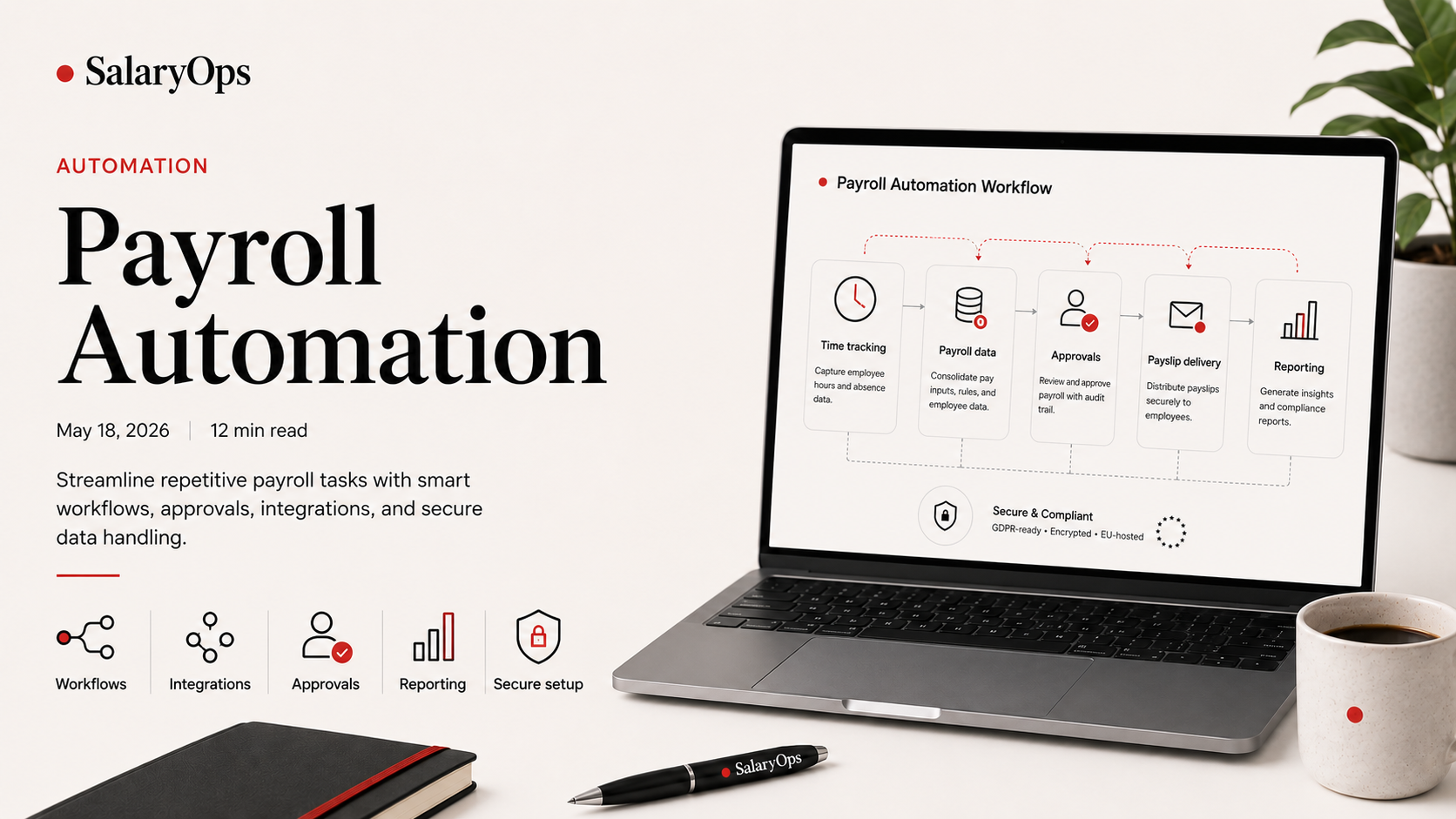
Manual payroll isn't a moral failure. It's just what happens when the payroll process grows faster than the controls around it.
At first, the "manual bits" feel harmless: a spreadsheet here, a quick copy-paste there, one person who knows the workaround. Then reality hits: sick leave, retro pay, new pension rules, a system update, a new country, a new union agreement. Suddenly the payroll run is held together by memory and heroics.
If you're wondering whether your payroll process has become too manual, here are five signs I see again and again - plus the practical next step for each one.
1) Your payroll run depends on spreadsheets, copy-paste, and "manual bridging" between systems
What it looks like in real life
- You export employee master data from HR, clean it up, then upload it to payroll.
- You copy time and absence files into a template "because the integration isn't quite right."
- You maintain a "payroll truth" spreadsheet because no system shows the full picture.
Why it's a red flag
Spreadsheets aren't the enemy. Uncontrolled spreadsheets are.
The moment your payroll depends on manual data movement, you've created two problems:
- Data coherence risk: the same field (salary, cost centre, work schedule) means different things across systems.
- Audit trail risk: decisions and changes live in emails, chats, and someone's desktop.
A useful industry signal: the American Payroll Association's 2024 "Getting the World Paid" survey highlights that payroll data input errors remain a frequent issue for many teams - an outcome that's hard to avoid when data is handled manually.
What to do next (small and controllable)
- Make a simple "manual handoff list": every export/import/copy-paste step, who does it, and when.
- Pick one handoff and add a control: a validation rule, a reconciliation check, or a standard pre-run report.
- Only then consider automation. Automation without control just moves the mess faster.
2) You're doing corrections every payroll cycle (and calling it "normal")
What it looks like in real life
- Adjustments are created after payroll is calculated because "that always happens."
- Retroactive fixes are handled as a separate mini-payroll every month.
- The same types of mistakes keep returning (wrong allowance, missing overtime code, incorrect tax setup).
Why it's a red flag
Corrections aren't just annoying. They're evidence.
If the same error appears more than once, the question is not only "Who made the mistake?" The better question is: "Why was the process able to produce this error again?"
Correction volume is also a cost indicator. HR Dive reported on research (citing EY) suggesting employers average many pay corrections per pay period, costing significant time and money across a year.
What to do next (turn errors into learning)
Start an error log that's actually a working tool: error type, root cause, where it should have been caught, and which control would prevent it.
Pick one recurring error and build one fixed control.
Examples:
- A pre-run report that flags negative net pay or unusually high variable pay.
- A rule that blocks payroll calculation if mandatory fields are missing.
- A monthly reconciliation between payroll output and finance posting.
3) Payroll deadlines slip, approvals pile up, and "we'll pay on time" feels like a monthly gamble
What it looks like in real life
- The run starts earlier and earlier "just to be safe."
- Approvals are handled via email chains.
- One absence (holiday/sick leave) derails the timeline.
Why it's a red flag
A payroll process that only works under ideal conditions is not a working payroll process.
Late pay is also more common than many organisations want to admit. SD Worx reported that 21% of employees in Ireland were paid late multiple times in a 12-month period, and 27% reported salary calculation errors. The details vary by country, but the pattern is familiar: manual steps and fragile workflows increase the chance of delays.
What to do next (stabilise the run)
- Write down your payroll calendar as a process, not a date list: inputs, cut-offs, controls, approvals, and owners.
- Replace "approval by email" with a clear checkpoint: what is being approved (inputs, exceptions, final gross-to-net) and what evidence is required.
- Build a "minimum viable payroll run": the smallest set of steps that still produces a compliant, controlled pay run - even when someone is away.
4) Compliance and reporting are handled as last-minute manual work
What it looks like in real life
- Statutory reporting involves exporting files, reformatting, and manual adjustments.
- You rely on someone's knowledge of "how we do it in this company."
- Audit questions trigger a scramble for screenshots and spreadsheets.
Why it's a red flag
Compliance isn't just the filings. It's whether your process can prove what happened and why.
Manual reporting steps usually mean one of two things:
- The data quality upstream is inconsistent.
- Controls are procedural (people remembering) rather than systemic (the process catching issues).
Several payroll practitioners and providers have pointed out how manual payroll processes increase compliance risk at scale because audit trails fragment and late adjustments create reporting mismatches.
What to do next (make compliance boring)
Identify your compliance "pressure points": statutory submissions, pensions, tax, union reports, year-end.
For each pressure point, define:
- Input source (which system is the source of truth?)
- Validation (what must be true before submission?)
- Evidence (what do you keep for audit?)
Turn those into repeatable controls. Not heroic knowledge.
5) Your process only works because one person remembers the workaround
What it looks like in real life
- "Ask Donna, she knows the exception."
- A key integration needs manual cleanup every month.
- Certain employee groups (expats, shift workers, multiple contracts) always require special handling.
Why it's a red flag
My memory is not a control.
A payroll process that depends on personal habits is fragile by definition. It will break during holidays, turnover, reorganisations, system upgrades, and acquisitions.
This is also where "automation" conversations often go wrong. The market is clearly moving toward more automation and AI support in payroll (for example, SD Worx reported 42% of UK companies now use AI in payroll). But using more tech doesn't fix a process that isn't documented, controlled, and understandable.
What to do next (remove person-dependency)
Document the workaround as a process step: trigger, action, expected outcome, and check.
Decide whether it should be:
- Eliminated (fix the upstream data/integration)
- Standardised (turn it into a controlled workflow)
- Automated (only after you can test and validate it)
If an integration still requires regular manual cleanup, it's not finished. It's just transporting work.
A quick self-check: if you recognise 2-3 of these signs
You don't need a "payroll transformation programme." You need control, clarity, and a few well-chosen improvements.
Start here:
- List every manual handoff and recurring correction.
- Pick the one that creates the most risk or rework.
- Add one control that catches the issue earlier.
- Only then automate the recurring task - small, testable, and maintainable.
Conclusion: Less payroll hassle starts with more control
Manual payroll is rarely "just extra admin." It's usually a signal that the process is carrying risk it can't see.
The good news: you can improve a manual payroll process without big promises, shiny tools, or polished chaos. The fastest wins typically come from turning recurring errors into fixed controls and making data flows coherent across HR, time, payroll, and finance.
Structure your payroll process in 8 days.
A free 8-day email series for payroll specialists, managers and HR/finance teams. Practical examples on structure, controls and automation — no technical experience required.
- · one short email per day for 8 days
- · payroll workflow examples
- · control principles
- · n8n as part of the setup
- · free — unsubscribe anytime