
Who Owns Payroll Accuracy? A Practical Responsibility Map for HR, Finance, Managers, and Payroll
Payroll accuracy is not one person's job; it's a chain of responsibilities. This post maps out who owns which aspects of payroll accuracy among HR, Finance, Managers, and Payroll, defining key control points and reducing post-payday arguments.
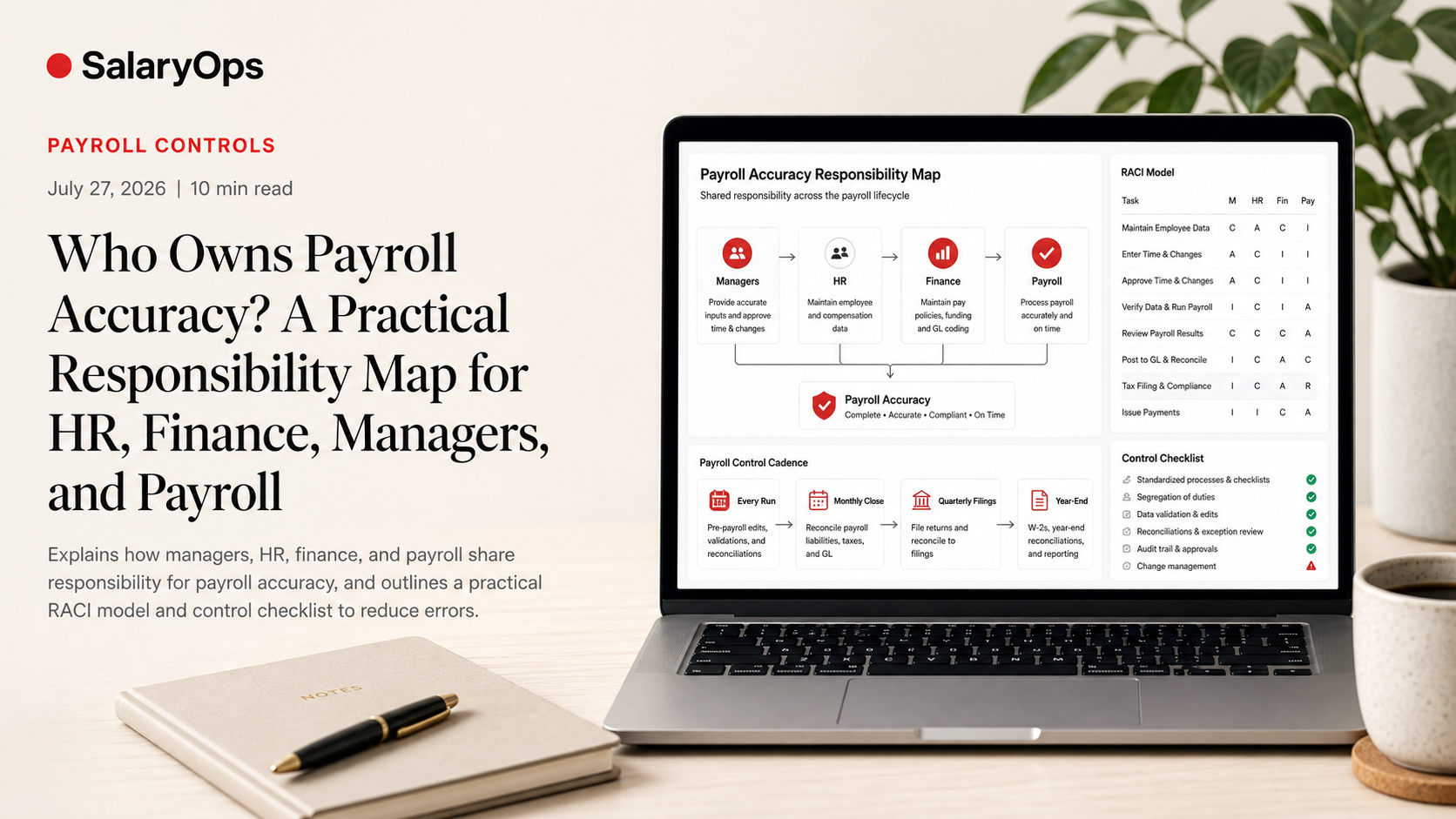
Who Owns Payroll Accuracy? A Practical Responsibility Map for HR, Finance, Managers, and Payroll
Payroll accuracy sounds like a simple question until something goes wrong.
A manager approved the timesheet. HR entered the new salary. Finance signed off on the payroll funding. Payroll submitted the file. Then an employee gets paid wrong.
Cue the familiar debate (including plenty of it online): “If the manager approved hours, why is payroll still getting blamed?”
The uncomfortable truth is that “responsible for payroll accuracy” is not one job. It is a chain of responsibilities, with different people owning different types of accuracy. If you do not define that chain, you end up running payroll on vibes and memory, and then arguing about accountability after the fact.
This article lays out a practical responsibility map you can actually use: what managers own, what HR owns, what finance owns, what payroll owns, and where “final submission” fits into internal control best practice.
Why this confusion keeps happening
Most payroll errors are not “payroll math” problems. They are input, timing, or interpretation problems.
A few very normal examples:
- A manager approves a timecard that is complete, but not compliant (missed break rule, wrong premium code, incorrect project/cost center).
- HR processes a compensation change with an effective date that does not match the local pay cycle rules.
- Finance changes cost center structures mid-month and nobody updates the mapping in time.
- Payroll receives approved time, but a late absence correction comes in after approval.
In other words: a manager’s approval is not a magical quality stamp over the entire payroll result. It is approval of one slice of the data.
This is why many internal control frameworks emphasize segregation of duties and independent review: time data is entered, then independently approved by a supervisor, then processed and reviewed before payment. That separation is repeatedly cited as a core control in payroll review and segregation-of-duties guidance across institutions and payroll governance materials.
Define “payroll accuracy” before you assign ownership
When people argue about payroll responsibility, they often mean different things.
Payroll accuracy usually includes at least four categories:
- Time and attendance accuracy
Did the hours, absences, premiums, and on-call entries reflect reality? - Master data accuracy
Is the employee data correct (hire/termination dates, FTE, salary/hourly rate, bank details, tax setup, union/benefit eligibility, work location, cost center)? - Calculation and compliance accuracy
Were pay rules, overtime, statutory deductions, and benefits applied correctly according to policy and local regulation? - Process accuracy (controls and timing)
Did changes arrive on time, were they approved correctly, were exceptions handled consistently, and is there an audit trail?
Once you split accuracy into these buckets, role ownership becomes much easier (and a lot less emotional).
A practical responsibility map: who owns what
Think in terms of “data ownership” and “process ownership.”
- Data ownership means: you are accountable for the correctness of the information you create or approve.
- Process ownership means: you are accountable for running a controlled, auditable workflow that catches issues before money leaves the building.
Most organizations need both.
Managers: accountable for time reality and local context
Managers are typically the only people close enough to validate “what actually happened.” That makes them accountable for:
- Approving worked hours, absences, shift differentials, on-call, and ad-hoc premiums
- Confirming schedule changes, swaps, and exceptions
- Ensuring time is submitted on time (cut-off discipline)
- Spotting obvious anomalies (e.g., 26 hours in a day, missing time, duplicated shifts)
What managers are not realistically accountable for:
- Tax calculation correctness
- Payroll system configuration
- Country-specific compliance interpretation (unless you want to train managers into mini-payroll specialists, which tends to end badly)
A useful way to phrase it internally:
Manager approval is approval of the time record as true and complete, not approval of the final payslip.
HR: accountable for people master data and policy intent
HR (or People Ops) usually owns the master data that drives pay eligibility and amounts. HR is accountable for:
- Accurate, timely employee lifecycle events (hire, rehire, termination)
- Contract terms and compensation changes (rates, salary, allowances, benefits eligibility)
- Correct effective dates and supporting documentation
- Policy clarity (what the rules are supposed to be)
Where HR can unintentionally create payroll errors:
- Late changes posted after cut-off without an agreed correction process
- “Policy intent” that is not implementable in payroll rules (or implemented inconsistently)
Payroll needs HR to be precise. “Effective sometime last month” is not a payroll-friendly data field.
Finance: accountable for funding, reconciliation, and financial integrity
Finance typically owns the money side and the reporting side. Finance is accountable for:
- Payroll funding readiness and cash planning
- GL mapping, cost allocation structures, and reporting requirements
- Reconciliation between payroll outputs and financial statements
- Detecting unusual spend patterns and enforcing financial controls
A common failure mode is when finance assumes payroll “just posts correctly” without actively owning the mapping rules, cost center governance, or reconciliation cadence.
Payroll: accountable for the controlled process and the final output
Payroll is the function that presses “go” (or transmits the final file). That creates an unavoidable accountability: the final payroll output must be reviewed and defensible.
Payroll is accountable for:
- Running the payroll calendar and cut-offs (and enforcing them)
- Validating input completeness (time approvals done, required HR changes received)
- Processing correctly in the payroll system (batch control, pay run steps)
- Running pre-payroll controls (variance checks, exception reports, sampling)
- Ensuring compliance application as configured (and escalating when policy or data conflicts appear)
- Maintaining audit trail and documentation of adjustments
This is the nuance that often gets lost in “manager approved it” arguments:
Manager approval reduces risk. It does not remove payroll’s duty to run controls.
Good payroll teams do not rely on individual memory or “it looked fine.” They rely on repeatable checks. If the same error happens twice, the process is missing a control.
So who is ultimately responsible?
If you want a single sentence that holds up in real operations:
Payroll is responsible for the accuracy of the final pay run output, but they cannot be the sole owner of every input that creates it.
In governance terms, payroll owns the process and the final submission. Managers and HR own the data they approve or create. Finance owns the financial integrity and reconciliation.
Many organizations formalize this using segregation of duties: one person enters data, a different person approves it, payroll processes it, and a separate review/approval step happens before payment is released. That independent review model is widely referenced in payroll control guidance because it reduces both error and fraud risk.
A simple RACI model you can adopt
Below is a practical, generic RACI (Responsible, Accountable, Consulted, Informed). Adapt the labels to your org, but keep the logic.
- Timesheet entry (employee or time admin)
- Responsible: Employee / Time Admin
- Accountable: Manager
- Consulted: Payroll
- Informed: HR
- Timesheet approval
- Responsible: Manager
- Accountable: Manager
- Consulted: Payroll (for rule interpretation)
- Informed: HR
- HR master data changes (comp, contract, lifecycle)
- Responsible: HR
- Accountable: HR
- Consulted: Payroll (for cut-off impact)
- Informed: Finance
- Payroll processing and pre-payroll controls
- Responsible: Payroll
- Accountable: Payroll
- Consulted: HR (for data questions), Managers (for time exceptions)
- Informed: Finance
- Final payroll approval (pre-release sign-off)
- Responsible: Payroll (prepare), Finance/HR leadership (sign-off depends on governance)
- Accountable: Finance/HR leadership (joint or defined owner)
- Consulted: Payroll
- Informed: Managers (where relevant)
- Posting, payment release, and reconciliation
- Responsible: Finance (payments/recon) + Payroll (posting support)
- Accountable: Finance
- Consulted: Payroll
- Informed: HR
Two important notes:
- If payroll is both processing and also the only approver, your control environment is weak. You need either a separate approver or compensating controls.
- If managers approve time but there is no documented deadline enforcement, your “approval” becomes symbolic. Payroll then spends the last two days chasing data, which is not a control. It is hope.
What to do when something is wrong after manager approval
This is where Reddit-style debates usually land: “Manager approved. Employee still got paid wrong. Now what?”
A practical, fair approach is to separate root cause from point of detection.
- If the time record was wrong but approved: the manager owns the root cause, payroll owns catching it only if a defined control should have flagged it.
- If the time record was correct but the system calculated it wrong: payroll (and whoever owns configuration) owns it.
- If the time record was correct but the pay code mapping or eligibility was wrong due to HR data: HR owns it.
- If the pay was correct but posted to the wrong cost center: finance owns the mapping governance, payroll supports correction.
The goal is not to find a villain. The goal is to convert the error into a fixed, repeatable control so it does not come back next month.
The “controls over blame” checklist
If you want less role conflict, these are the operational habits that remove most ambiguity:
- Define cut-offs (time entry, approvals, HR changes) and stick to them.
- Make approvals meaningful: managers must know what they are approving (hours, premiums, exceptions).
- Use exception-based payroll controls (variance reports, negative net pay, unusually high overtime, one-time payments over thresholds).
- Keep an audit trail: who changed what, when, and why.
- Separate duties where possible: entry, approval, processing, and release.
- Run a structured post-pay reconciliation between payroll output and finance reporting.
This is not glamorous. It is also the difference between a payroll process that survives holidays, absences, and employee changes-and one that only works because one person remembers the workaround.
Conclusion
Payroll accuracy is not owned by a single department. It is produced by a chain: managers validate reality, HR governs people data, payroll runs controlled processing and review, and finance ensures the numbers reconcile and the money side is correct.
When the chain is clear, “manager approved it” stops being an argument and becomes what it should be: one control among several. The most reliable payroll operations are the ones that treat responsibility as a design problem-solved with clear ownership, segregation of duties, and repeatable checks-rather than a blame problem solved after payday.
Structure your payroll process in 8 days.
A free 8-day email series for payroll specialists, managers and HR/finance teams. Practical examples on structure, controls and automation — no technical experience required.
- · one short email per day for 8 days
- · payroll workflow examples
- · control principles
- · n8n as part of the setup
- · free — unsubscribe anytime